Live on our test environment
Stablecoin banking rails, settled and confirmed in seconds.
nupont connects the bank infrastructure you already run with public stablecoins for faster settlement, freed-up liquidity, and full regulatory compliance. Without changing your core systems.
30 minutes · no prep needed
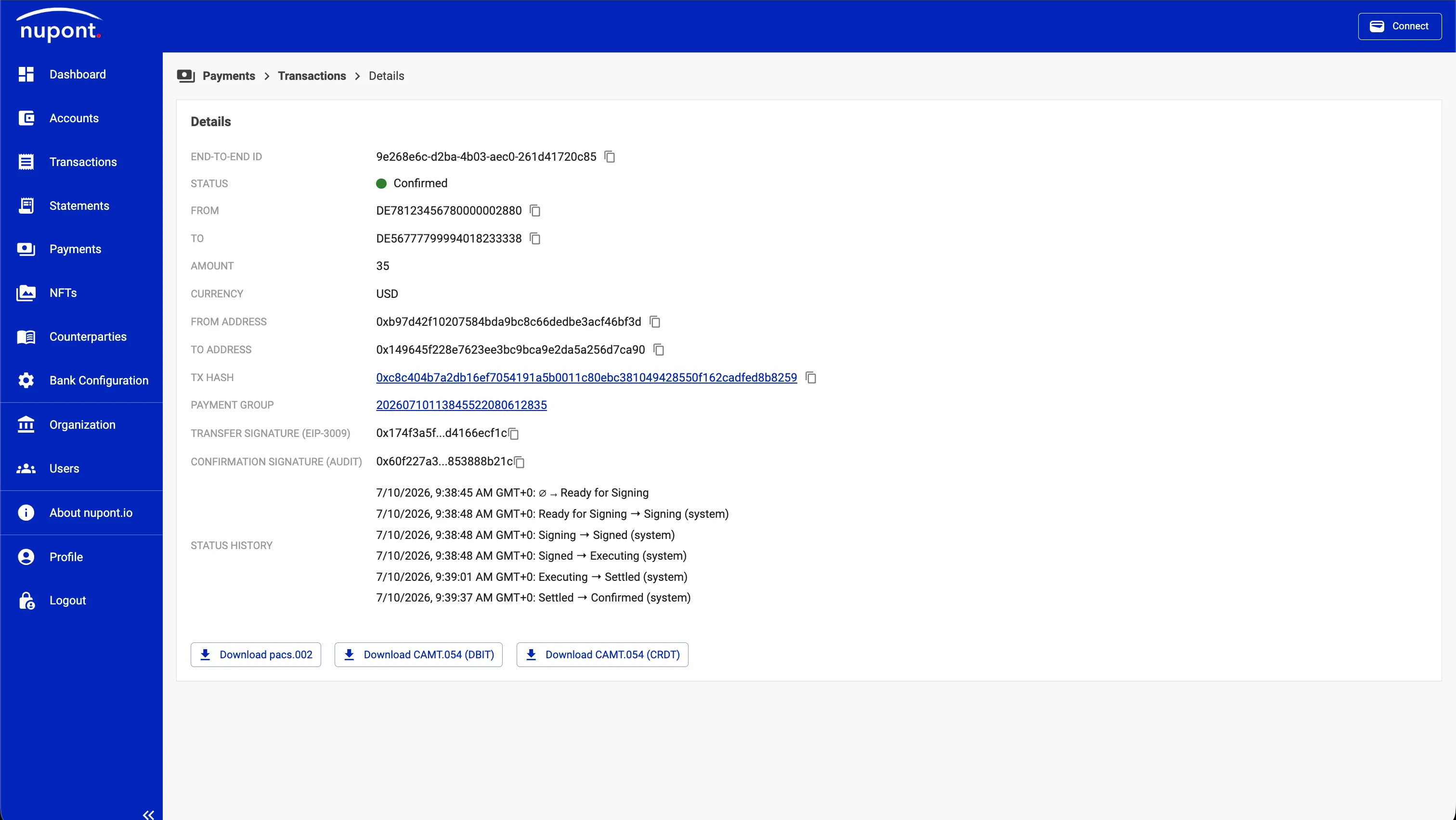
Real payment detail from the nupont test environment
At a glance
Why banks are moving to stablecoins as a settlement rail
30 sec.
Speed
Settlement in roughly 30 seconds, around the clock. No cutoff times, no weekends, no delays from correspondent banks.
3–5 days today → seconds on the blockchain
€7M+
Liquidity*
No capital sits permanently in prefunded nostro accounts. Your settlement stablecoin buffer is used with every payment.
Prefunded nostro accounts → just-in-time funding
-70%
Cost**
No correspondent fees, no withdrawal fees, no FX margin stacked across multiple transaction hops. The bank keeps the corridor margin instead of passing it along the chain.
Fee chain → a single network fee + nupont
*Model calculation: €7M+ based on €500M annual volume × 4 days of coverage × a safety factor. Actual value depends on the customer.
**Model calculation: a typical payment routed through 4 correspondent-bank hops, each charging a $20 fee.
What changes with nupont
What changes technically
A webhook between your bank and nupont, a settlement stablecoin wallet key in your HSM, and a BIC-to-wallet entry per partner bank.
What stays the same
Your core banking system, online banking frontend, HSM infrastructure, ISO 20022 messaging, sanctions screening, EBICS/sFTP delivery, and AML/KYC workflows.
How onboarding works
Start with a PoC on one currency corridor and one or two target banks. First test payment on testnet within 4–6 weeks; production go-live in 6–9 months. Integration runs via B+S.
Payments
Cross-border payments still cost your bank capital, time, and margin
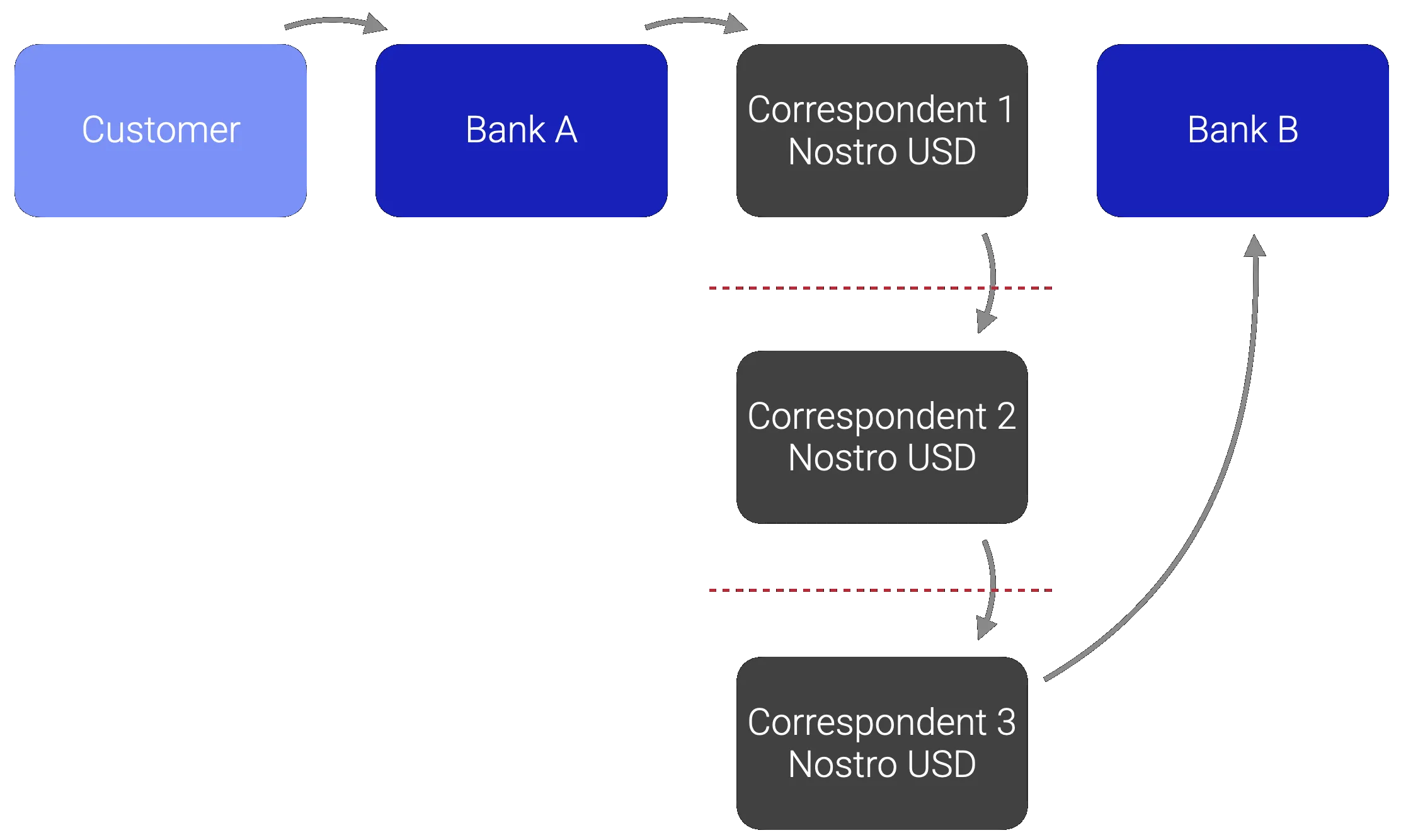
A single corporate cross-border USD payment still passes through several correspondent banks, ties up seven figures of capital in non-interest-bearing nostro accounts, and takes 3–5 days to settle. Your customer has no visibility. Your treasury carries the cost.
One infrastructure. Settlement and messaging happen in sync.

nupont compresses the correspondent bank chain. It's the same pacs.008 your bank already sends today. The value just moves over a public stablecoin rail instead of through a chain of correspondent banks.
Your bank keeps the entire customer relationship. nupont provides the technical infrastructure behind the scenes.
- The same ISO 20022 formats your operations team already uses
- Your online banking frontend stays unchanged
- Customers send a pain.001 file or just use online banking as usual
- Settlement completes in seconds instead of days
- Account statements arrive as camt.054 and camt.053, directly into your core banking system
IT & Architecture
Four steps. Standards in, standards out.
Step 1
The bank initiates the payment
pacs.008 · USD
Step 2
nupont prepares the on-chain transfer
ERC-3009 · Gas paid by nupont
Step 3
The bank signs with its own HSM
EIP-712 · The key stays with the bank
Step 4
Account statements close the loop
camt.054 intraday · camt.053 end of day
▸ Show step-by-step details
Step 1
The bank initiates the payment
pacs.008 · USD
Step 2
nupont prepares the on-chain transfer
ERC-3009 · Gas paid by nupont
Step 3
The bank signs with its own HSM
EIP-712 · The key stays with the bank
Step 4
Account statements close the loop
camt.054 intraday · camt.053 end of day
Step 1
Your customer instructs a USD payment through the online banking frontend. The FX conversion (EUR → USD) is booked, then the bank sends a standard pacs.008 file to nupont via webhook or message queue. Nothing changes on your side.
Step 2
nupont maps the receiving bank's BIC to the agreed settlement stablecoin's wallet address (e.g. USDC), prepares the transfer, and covers the gas fee, so your bank never needs to hold ETH. The unsigned transaction is queued for the bank's HSM.
Step 3
Your bank's hardware security module signs the transaction with its own settlement stablecoin wallet key. Private keys never leave the bank. nupont is a technical coordinator, not a custodian, not a CASP.
Step 4
nupont's indexer detects the transfer on-chain. An intraday camt.054 goes to both banks immediately: proof of settlement within seconds. The camt.053 follows for end-of-day booking. Standard ISO 20022, straight into your core banking system.
ISO 20022 account statements.
Patented: EP 4 325 416 B1 · US 12,462,296 B2
nupont's blockchain indexer watches every on-chain transaction and converts it into the banking formats your systems already process, with no manual reconciliation and no separate reporting workflow. Both the sending and receiving bank get a full set of account statements for every payment:
- camt.054: intraday status report, delivered within seconds of on-chain confirmation
- camt.053: end-of-day booking statement, ready to post without manual work
- Delivered straight into your existing systems, via queue, EBICS, or sFTP
- Also available: MT940 / MT942 / BAI, for monitoring crypto accounts
The same settlement infrastructure that powers cross-border payments also supports corporate clients holding their own stablecoin or crypto accounts, giving them a consolidated view of fiat and digital assets through a single banking channel.
Minimal change. Maximum impact.
What stays the same
Core banking system, online banking frontend, HSM infrastructure, ISO 20022 messaging, sanctions screening, EBICS/sFTP delivery, ERP integration, AML and KYC workflows.
What's new
A webhook between the bank and nupont. A settlement stablecoin wallet key in the bank's HSM. A BIC-to-wallet entry per partner bank.
Compliance & Legal
Built for the MiCAR and GENIUS era. No new crypto or banking license required in the EU or US.*
Regulatory clarity is the foundation of the concept. nupont operates as a technical service provider in the background. Your bank remains the regulated party throughout.
- ✓ Keys stay with the bank. Settlement stablecoin wallet keys live in the bank's own HSM and are signed internally, never exported. Fully auditable within your existing key management setup.
- ✓ nupont is not a custodian. nupont never holds, manages, or transfers customer assets. We prepare the transaction. The bank executes it by signing.
- ✓ The settlement stablecoin is a regulated instrument. The settlement stablecoin used for a payment (for example USDC) qualifies as an e-money token under MiCAR in the EU, or as a payment stablecoin under the GENIUS Act in the US. Its issuer is the regulated party; the bank remains the regulated counterparty. Your existing AML, sanctions, and reporting workflows apply unchanged.
- ✓ Your customer never sees the settlement stablecoin. The customer pays in e.g. euros, the recipient receives e.g. US dollars. The settlement stablecoin is infrastructure between banks, not a product offered to customers.
- ✓ Patent-protected technology. nupont's on-chain transaction detection and reconciliation method is patented: EP 4 325 416 B1 (EPO) and US 12,462,296 B2 (USPTO).
*Based on nupont's technical-service-provider model under current MiCAR (EU) and GENIUS Act (US) frameworks, as of August 2026. Regulatory treatment can vary by jurisdiction and use case. Consult your own legal and compliance team before relying on this classification.